It’s raining (or snowing) again, the kids have been inside all morning, and the tablet is already calling their name. Every parent in the GTA knows this moment. The easy option is another hour of screens. The better option is something that gets children moving, thinking and talking to each other – and leaves the whole family with a story to tell at dinner.
Here is a simple plan for a rainy day or cold weekend in Vaughan that your kids will actually remember: easy ideas at home, three science experiments you can do with everyday supplies, and a hands-on outing when everyone needs to get out of the house.
Tip: save this post for your next indoor day – the experiments below take 10 to 20 minutes each.
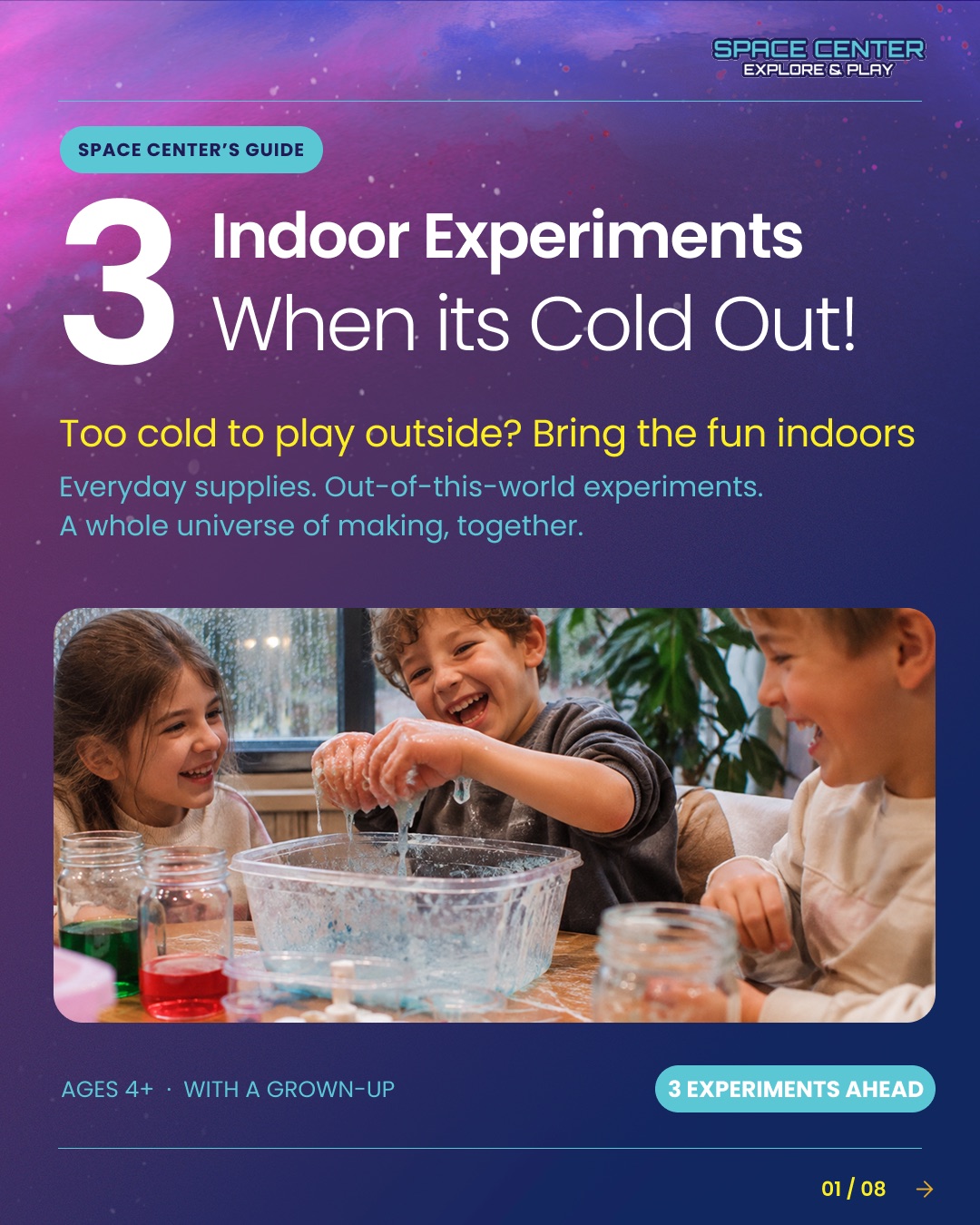
Why “something to do” is not enough
Not all indoor activities are equal. Two hours in front of a screen and two hours of active, curious play may both keep children busy, but they leave them in a very different state. When choosing where to go or what to do, look for activities that combine four things:
- Movement – climbing, balancing, running, coordinating their bodies.
- Exploration – something new to discover, touch and figure out.
- Connection – playing with other children and with you, not next to a device.
- Learning without pressure – kids pick up real ideas without feeling like they are at school.
The best family days hit all four.
4 screen-free ideas at home
1. Build a rocket challenge
Roll a strip of paper around a pencil, tape it, fold the top into a cone and slide it onto a drinking straw. Blow – and measure whose rocket flies the farthest. Then change one thing (longer body, bigger fins) and test again. That is real engineering.
2. Indoor scavenger hunt
Write a “mission list” of 10 things to find around the house: something round, something that floats, something older than you. Set a timer and let the crew race the clock.
3. Design your own planet
Paper, markers and imagination: what lives there, what is the weather like, how long is a day, and how would you get there? Ask kids to present their planet at dinner.
4. Living-room astronaut training
Balance on one foot for 30 seconds, crawl under a “laser” string, carry a cup of water across the room without spilling. Astronauts train balance and coordination too.
3 easy indoor science experiments for kids
From our Space Center Experiments series: three quick experiments with everyday supplies. Ages 4+, made together with a grown-up.
Experiment 1: Bouncy Bubbles (15 min)
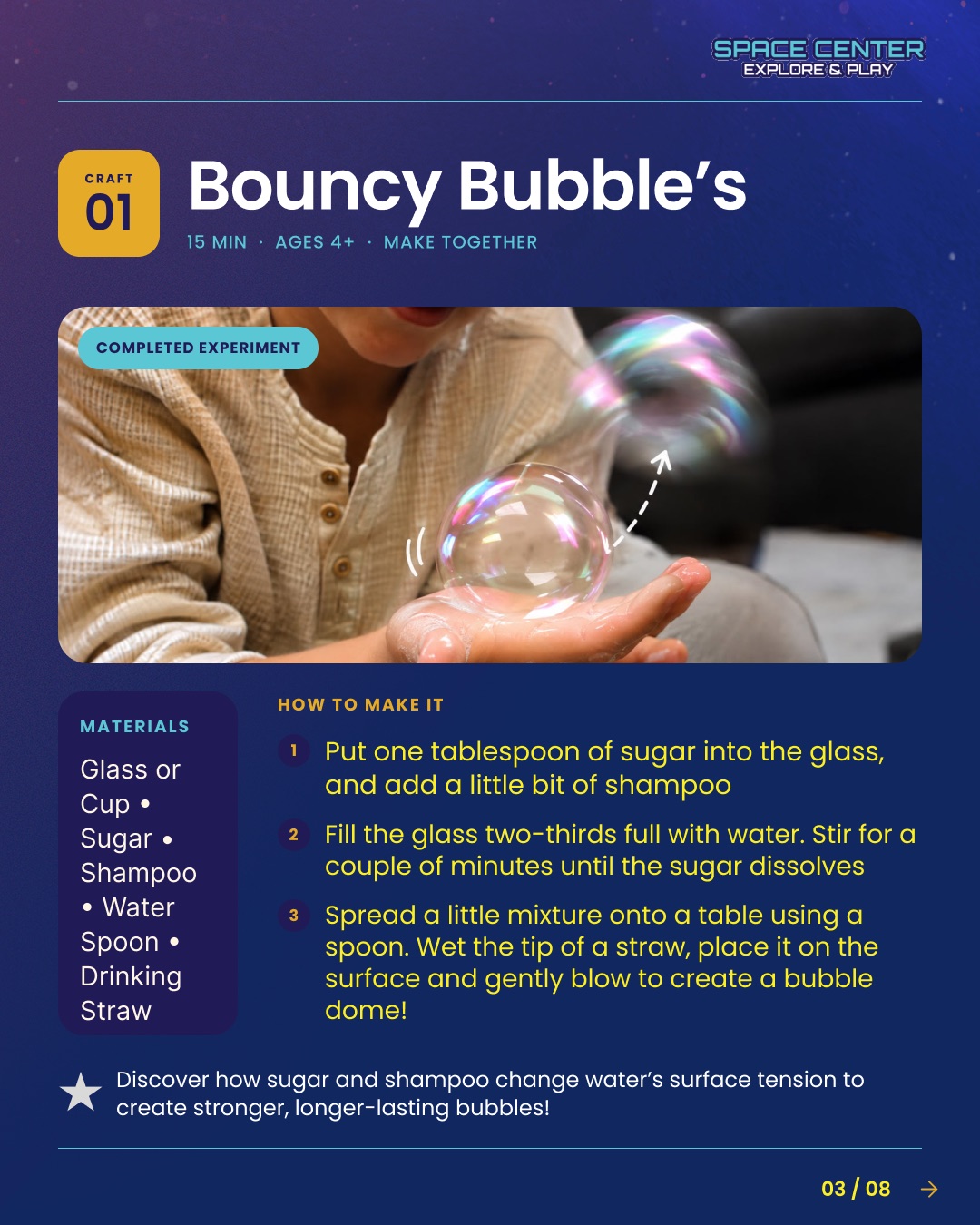
You will need: a glass or cup, sugar, shampoo, water, a spoon, a drinking straw.
- Put one tablespoon of sugar into the glass and add a little bit of shampoo.
- Fill the glass two-thirds full with water. Stir for a couple of minutes until the sugar dissolves.
- Spread a little mixture onto a table using a spoon. Wet the tip of a straw, place it on the surface and gently blow to create a bubble dome.
The science: sugar and shampoo change the water’s surface tension, so the bubbles become stronger and last longer.
Experiment 2: Water Shield (10 min)
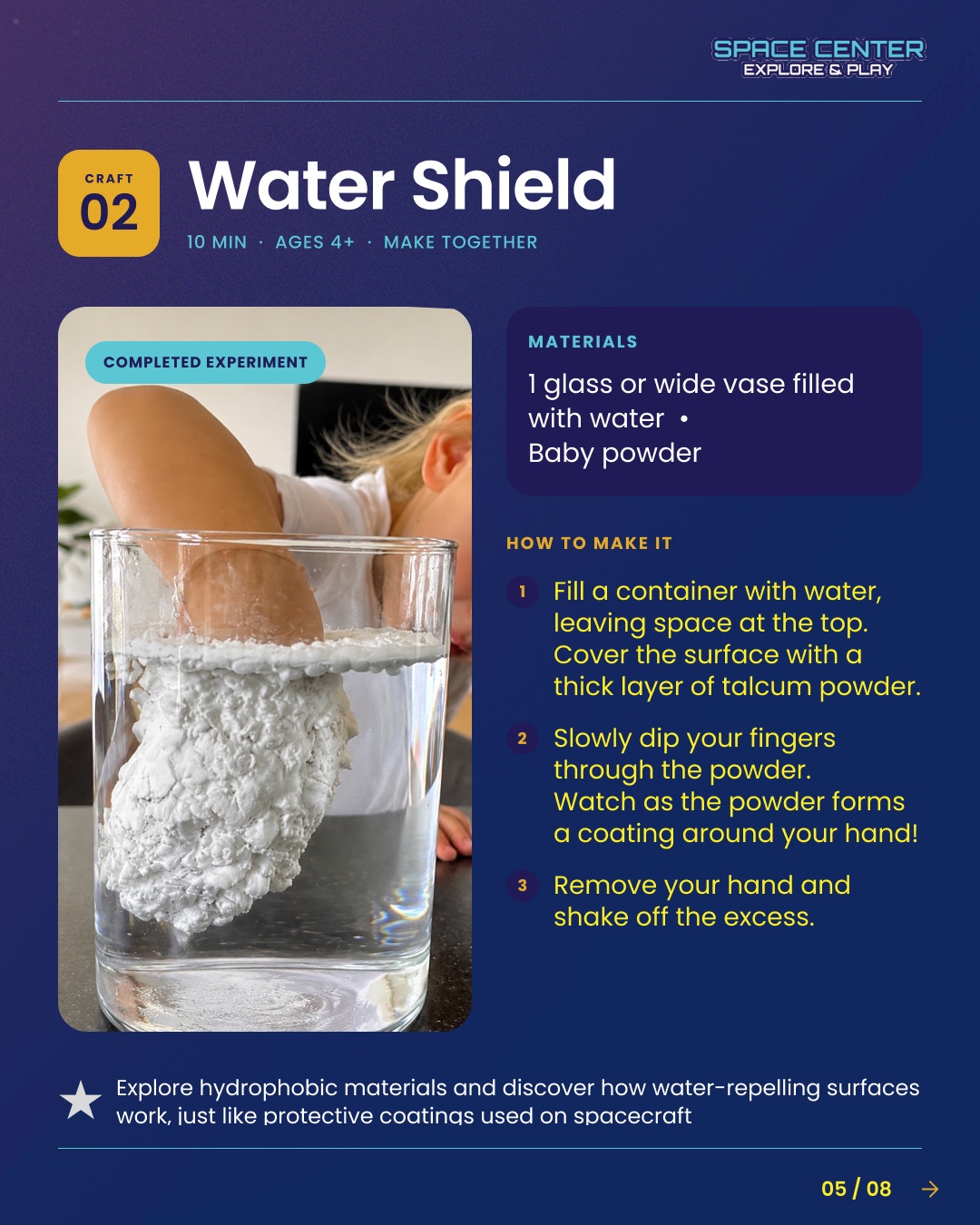
You will need: a glass or wide vase filled with water, baby powder.
- Fill a container with water, leaving space at the top. Cover the surface with a thick layer of talcum powder.
- Slowly dip your fingers through the powder. Watch as the powder forms a coating around your hand.
- Remove your hand and shake off the excess – your fingers stay dry!
The science: the powder is hydrophobic – it repels water. Engineers use the same idea for water-repelling coatings, including materials used on spacecraft.
Experiment 3: Balloon Reaction (20 min)
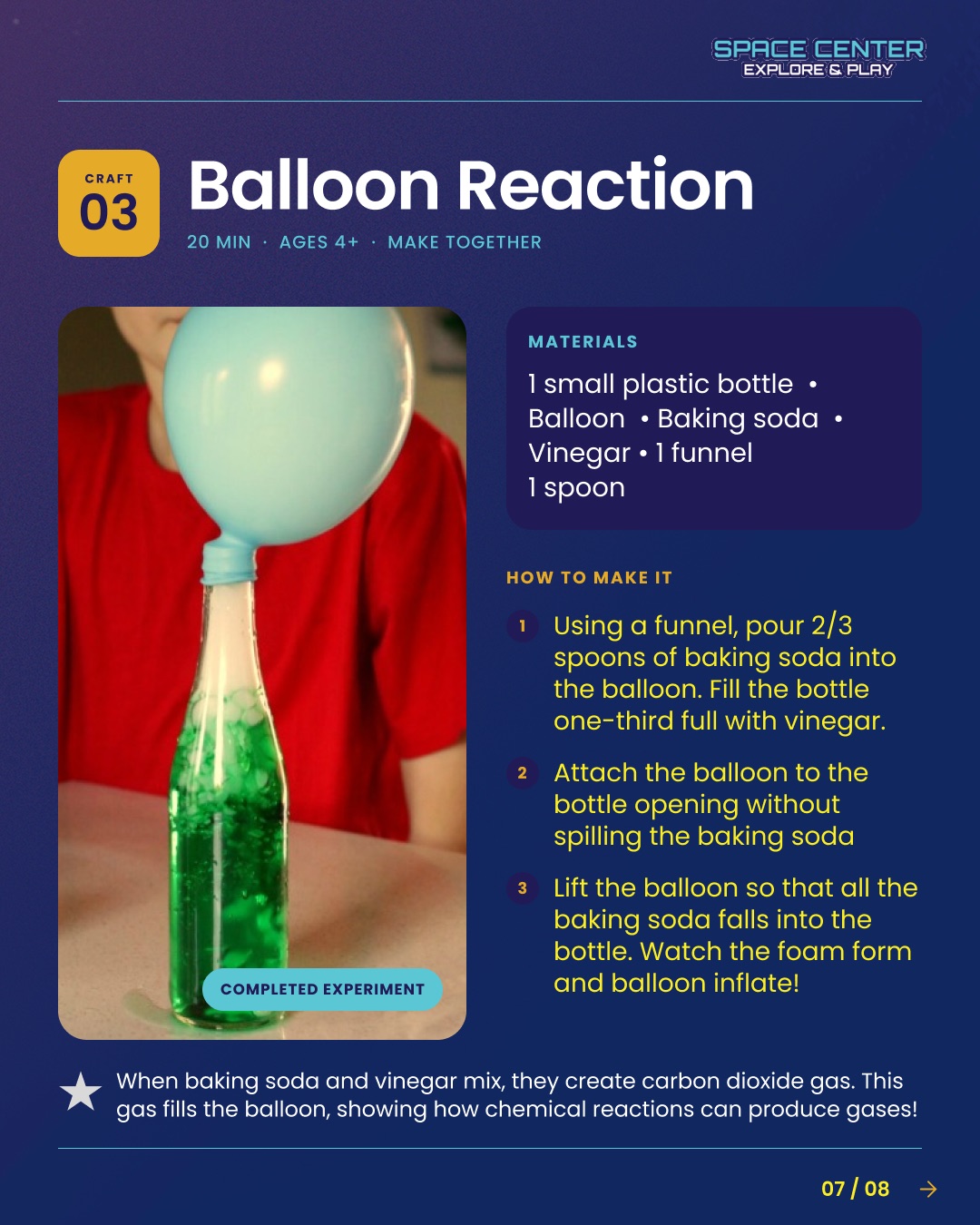
You will need: 1 small plastic bottle, a balloon, baking soda, vinegar, 1 funnel, 1 spoon.
- Using a funnel, pour 2-3 spoons of baking soda into the balloon. Fill the bottle one-third full with vinegar.
- Attach the balloon to the bottle opening without spilling the baking soda.
- Lift the balloon so that all the baking soda falls into the bottle. Watch the foam form and the balloon inflate!
The science: baking soda and vinegar create carbon dioxide gas, and the gas fills the balloon – a simple way to see a chemical reaction.
When you need to get out of the house
Sometimes the best thing for everyone is a change of scenery. Vaughan has plenty of indoor options, from libraries to play spaces. If your children are curious about space and science – or simply have energy to burn – a hands-on experience gives you both.
Space Center Vaughan: Explore & Play
Space Center is a new-format, space-themed edutainment experience for kids 5-11 and their families. Instead of arcade games or screens, children become young astronauts and complete an Astronaut Mission across 8 interactive zones:
- the Spaceport, where every mission begins next to a rocket preparing for launch to Mars;
- physical training and the Stability Room, inspired by real astronaut training;
- the Science Lab with hands-on experiments about motion, balance and forces;
- VR flight simulation: Mars rover, escape capsule or parachute descent;
- Zone 51, a playful alien-themed zone for creativity and hands-on science games.
The idea is simple: Fun with a Purpose. Kids learn about space, gravity, flight and forces through things they can see, touch and try – without the feeling of a classroom. Parents are welcome to join in and solve the mission together.
Good to know before you go
- Best for ages 5-11; kids under 5 enter free.
- General admission: 3 hours of play, from $21.99. With one VR experience: from $30.99. Late admission (2 hours): from $19.99.
- Non-slip socks are required for kids (available at reception for $5), regular socks for adults.
- Book online to skip the line – weekends can be busy.
- Address: 688 Chrislea Rd, Vaughan, with free parking.
A rainy day plan that works
- Morning: a quick home challenge – one experiment from this post or a rocket race.
- Midday: head out for a few hours of active, hands-on exploration.
- Evening: ask your kids to “report back” from their mission – what they discovered, what was hardest, what they want to try next time.
Rain doesn’t have to mean a lost day. It can be the day your child discovers they love science.
Save this post for your next indoor day, and share it with a parent who would love these ideas. New experiments are coming soon in our Space Center Experiments series.